


The total cost of AI software development in 2026
 The total cost of AI software development in 2026
 The total cost of AI software development in 2026
A few years ago, AI projects were still being pitched like magic tricks. A few prompts, a polished interface, maybe a model plugged into an API, and suddenly every company could imagine itself becoming “AI-powered.” In 2026, that fantasy does not survive first contact with reality. Building serious AI software is no longer about generating a clever demo. It is about designing something that can survive production, scale under pressure, stay compliant, and still make financial sense months after launch.
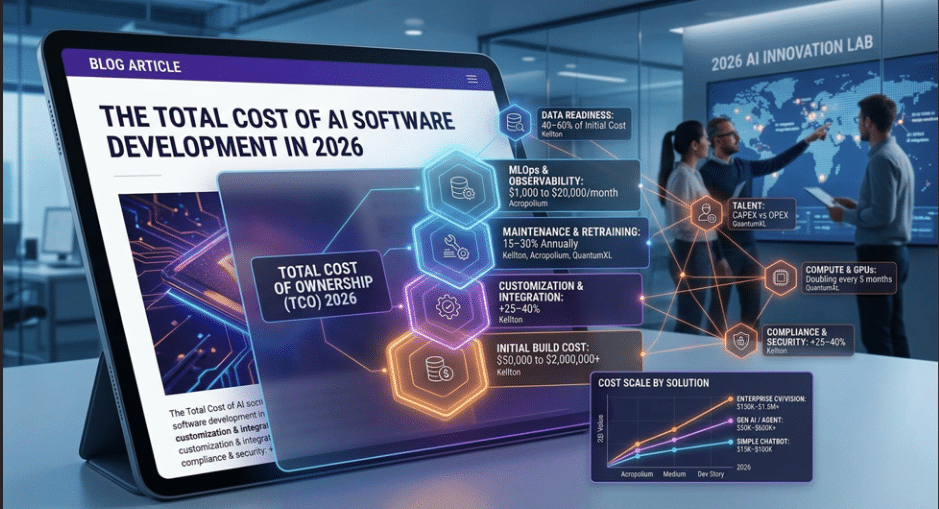
That is why ai software cost analysis has become one of the most important conversations in modern product development. The companies asking better questions are no longer focused only on what it takes to launch. They want to know what it costs to maintain model quality, to run infrastructure, to hire the right people, to manage risk, and to keep the system useful as the business changes. In other words, they are no longer budgeting for a build. They are budgeting for total cost of ownership.
That difference sounds subtle, but it changes everything.
The usual AI story starts with optimism. Leadership wants automation. Operations wants efficiency. Customer support wants faster responses. Sales wants smarter workflows. Someone sees a chatbot, a forecasting tool, or an internal AI assistant and assumes the path forward is straightforward: pick a model, connect a few systems, and let the software do the rest. For a few weeks, that idea feels plausible. Then the real work begins.
First comes infrastructure, which is often the biggest surprise. On paper, AI can look affordable because the early prototype does not seem that expensive. But prototypes are deceptive. They rarely reflect what happens once real users arrive, once data starts flowing in at scale, and once the system has to be reliable every day instead of just impressive during a demo. Suddenly the company is paying for GPU compute, storage, monitoring, logging, backup environments, orchestration, latency optimization, and security layers that no one mentioned in the kickoff meeting. The product still looks simple from the outside, but behind the curtain it starts to resemble a small industrial machine.
This is where many teams realize that AI does not behave like traditional software. A normal SaaS tool can often be deployed, monitored lightly, and improved over time with relatively predictable costs. AI systems are different. They are alive in a way ordinary software is not. They depend on data quality, inference demand, changing user behavior, model performance, and continuous tuning. The more successful the product becomes, the more expensive it can become to operate. Growth does not just bring revenue. In AI, growth can also bring larger monthly bills.
And infrastructure is only half the story.
The second shock comes from people. For all the talk about automation, AI remains painfully dependent on human expertise. Businesses still need machine learning engineers, MLOps specialists, backend developers, data engineers, AI security professionals, and technical leaders who understand how to connect all of this to a real business objective. In 2026, that talent is expensive because it has to be. There are plenty of people who can experiment with AI. There are far fewer who can make it reliable in production, explain its limits, secure it properly, and help a company avoid costly architectural mistakes.
That is why AI development salaries in 2026 are such a major part of the conversation. The labor market has shifted. Companies are not just competing for coders anymore; they are competing for people who can bridge engineering, operations, governance, and business logic. A senior AI hire today is often expected to understand model performance, cloud economics, data pipelines, vendor trade-offs, and regulatory exposure all at once. That kind of range is rare, and rare talent changes the math of every project.
Still, the most expensive part of AI is often not what companies can see. It is what they forget to include.
Data is one of the clearest examples. Every executive wants better AI outputs, but far fewer want to pay for the quiet, messy work required to make the data usable. Cleaning historical records, structuring inputs, removing noise, labeling edge cases, and creating reliable pipelines can consume more time than the model work itself. Yet without that foundation, even the most advanced AI stack will produce mediocre results. The model gets the attention, but the data determines whether the system deserves trust.
Then comes model drift, the problem many teams only understand after launch. An AI system that performs well in month one may begin underperforming in month six because user behavior shifts, language changes, markets evolve, or operational patterns no longer match the training data. Unlike static software, AI can quietly become less accurate over time without technically “breaking.” That means maintenance is not optional. Retraining, monitoring, evaluation, and human oversight all become part of the long-term operating model.
Compliance adds another layer of cost, especially for businesses in finance, healthcare, utilities, or any environment where decisions have consequences beyond convenience. In 2026, companies cannot afford to treat governance as an afterthought. Auditability, explainability, privacy controls, access policies, bias testing, and documentation are now part of what it means to build responsibly. In regulated sectors, these requirements do not sit on the edge of the project. They sit at the center of it.
Integration may be the most underestimated cost of all. AI rarely works in isolation. It has to connect with CRMs, ERPs, internal databases, customer platforms, ticketing tools, document systems, and legacy software that was never designed for machine intelligence. That is where timelines stretch and budgets start to move. Not because the model failed, but because the business environment around it is complicated.
This is why smart companies have stopped asking the cheapest question in the room: “How fast can we build it?” A better question is, “What will this cost to keep valuable?” That is the mindset behind real total cost of ownership. It acknowledges that AI is not a one-time implementation. It is a system that must be funded, governed, measured, and improved over time.
The companies that do this well are not necessarily the ones spending the most. They are the ones spending with clarity. They know that a low-cost proof of concept can still become an expensive mistake if it is not built for reality. They understand that cloud bills, salaries, integration work, compliance requirements, and post-launch maintenance are not side notes. They are the business model of AI itself.
That is the real story of AI software development in 2026. The cost is not shocking because the technology is impressive. The cost is high because making AI dependable in the real world is still hard. And for companies serious about using it well, realism has become more valuable than hype.