


Digital Twins in Healthcare: Use Cases, Benefits, and Implementation Challenges
Digital Twins in Healthcare: Use Cases, Benefits, and Implementation Challenges
In the fast-evolving landscape of healthcare technology, we often talk about artificial intelligence and big data as the vanguards of the next revolution. However, there is a quieter, yet arguably more profound transformation occurring under the surface: the rise of the digital twin. While the concept originated in industrial engineering, used to simulate jet engines and manufacturing plants, it has quietly migrated into the human body, promising to transition medicine from a reactive discipline to a predictive, hyper-personalized science.
Beyond the Scan: What is a Digital Twin?
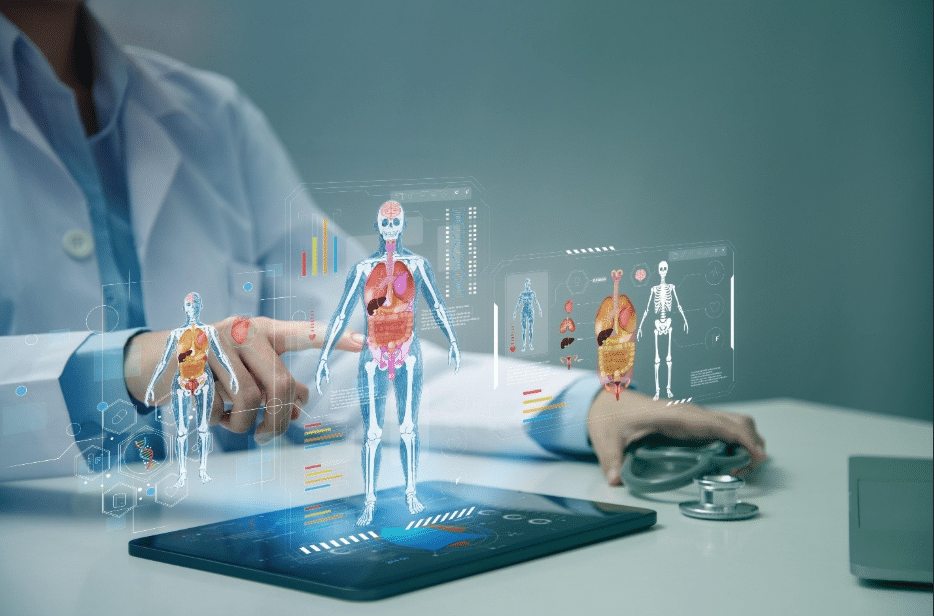
To the uninitiated, a digital twin might sound like a high-fidelity 3D model of an organ. In reality, it is far more complex. A digital twin is a dynamic, virtual replica of a physical entity, in this case, a patient, that is continuously updated with real-time data.
Imagine not just a static scan of your heart, but a living, breathing software model that incorporates your genetic profile, your lifestyle data from wearable devices, your blood chemistry, and your historical medical records. This model doesn’t just sit there, it performs simulations. If a doctor wants to know how your specific heart will react to a new medication, they don’t have to wait for you to experience side effects. They run the scenario on your digital twin first.
The “hidden” potential: In Silico Clinical Trials
One of the most fascinating aspects of digital twins in healthcare that the general public rarely hears about is the concept of in silico clinical trials. Traditionally, testing a new drug takes years and thousands of human participants, many of whom may experience adverse reactions.
Digital twins allow researchers to run these trials in a virtual environment. By creating a population of “virtual patients” with diverse biological profiles, scientists can test the efficacy and toxicity of a drug on thousands of digital avatars simultaneously. This doesn’t replace human trials, but it acts as a rigorous filter, ensuring that only the most promising and safe candidates ever reach human testing. It is a paradigm shift that could collapse the time-to-market for life-saving therapies while drastically reducing the risk of clinical trial failures.
Why This Matters: From Population Averages to You
Current medical practice relies heavily on “population averages.” We prescribe dosages based on what works for the “average” patient. But as any healthcare professional knows, there is no such thing as an average patient. Your metabolism, your stress levels, and your unique molecular structure mean your response to a therapy is entirely distinct.
Digital twins offer a path toward true precision medicine. Consider the implications for oncology:
- Virtual Biopsies: Instead of invasive procedures, doctors can simulate tumor growth patterns to predict how a cancer might metastasize.
- Surgical Rehearsal: Before touching a scalpel, a surgeon can perform a complex procedure on a patient’s digital twin, identifying potential complications in the vasculature or nerve endings that might not be obvious on a standard 2D image.
- Chronic Disease Management: For conditions like diabetes or COPD, digital twins can model a patient’s metabolic or respiratory response to treatment adjustments in real time, enabling proactive interventions before acute episodes occur, reducing hospitalizations and lowering long-term care costs.
- Hospital Operations Simulation: Digital twins are not limited to individual patients. Health systems can use them to simulate ICU capacity, patient flow through emergency departments, and surgical scheduling — enabling operational leaders to stress-test decisions before implementing them and reduce bottlenecks in high-demand periods.
- Pharmaceutical Manufacturing: Digital twins of bioreactors and drug manufacturing lines enable continuous process verification, reducing batch failures and accelerating scale-up — an area where the EU’s Pharma Legislation reform (2024) is actively encouraging adoption.
The Implementation Barriers: Data Quality, Privacy, and Governance
Despite the immense promise, the integration of digital twins into mainstream healthcare technology faces significant hurdles that go beyond the technical. We are essentially creating a data-driven version of a human life. This raises profound questions about data privacy, security, and the psychological impact of seeing one’s health “modeled” in real-time.
Furthermore, there is the issue of “data fidelity.” A digital twin is only as good as the data feeding it. If a patient’s wearable device provides inaccurate heart rate data or their electronic health record is incomplete, the “twin” becomes a distorted mirror. The industry is currently racing to develop standardized, high-integrity data pipelines that can ensure these models are medically actionable rather than just theoretical simulations.
Beyond data quality, CIOs face three additional barriers that are rarely discussed openly. First, interoperability: digital twins require continuous data streams from EHRs, PACS imaging systems, genomics labs, and wearable devices, all operating on different standards (HL7 FHIR, DICOM, proprietary APIs). Integrating these sources without data loss or latency is one of the hardest real-world engineering challenges in health IT today. Second, regulatory clearance: AI-driven simulation tools used in clinical decisions must pass FDA 510(k) or CE marking processes, which can take several years. The FEops HEARTguide case referenced in this article is one of the few platforms that has achieved this, a significant differentiator. Third, model governance: a digital twin trained on one patient population can degrade over time or perform poorly across different demographics. Ongoing model validation, bias auditing, and clinical oversight protocols must be built into any deployment strategy from day one.
There is also the infrastructure cost dimension that most analyst reports understate. Running real-time simulations on patient-specific models is computationally demanding. Whether deployed on cloud platforms (AWS HealthLake, Azure Health Data Services, Google Cloud Healthcare API) or on-premises HPC clusters, health systems must factor in significant capital expenditure, ongoing compute costs, and specialized MLOps talent to maintain and retrain models. For most mid-sized health systems, partnering with a validated platform vendor — rather than building in-house — will be the more pragmatic path to production.
Case Study: FEops HEARTguide — Patient-Specific Digital Twin for Cardiac Procedures
One of the most mature patient-specific digital twin applications in healthcare is FEops HEARTguide, a digital cardiac twin used to plan complex structural heart procedures such as transcatheter aortic valve implantation (TAVI).
In this workflow, the digital twin is built from the patient’s own cardiac imaging (CT scans), combined with AI-powered anatomical analysis. The resulting model simulates how a specific heart valve device will interact with the patient’s unique anatomy, predicting outcomes such as:
- Whether the device will fit securely without leakage
- Risks such as paravalvular leak or valve migration
- Optimal device size and placement angle
In validated studies, HEARTguide has been used to predict device–patient interactions after TAVI with high accuracy, enabling physicians to match patients to the right treatment at the right time and improve outcomes. For a CIO, this is a clear example of a regulated, data-driven decision-support tool that:
- Integrates with existing imaging and EHR systems
- Requires high-integrity data pipelines and validation
- Delivers measurable clinical value in a high-risk procedure
This is exactly the kind of use case where digital twins move from “interesting research” to operational, revenue-impacting technology.
The Road Ahead
According to Gartner’s Digital Health Hype Cycle, organ-specific digital twins are currently moving from the “Peak of Inflated Expectations” toward the “Slope of Enlightenment” , meaning validated, production-grade deployments are expected to become mainstream within 3 to 5 years. The FDA’s Digital Health Center of Excellence (DHCoE) has accelerated pre-submission pathways for AI/ML-based devices since 2023, reducing regulatory timelines for qualifying platforms. Meanwhile, the EU AI Act (effective 2025–2026 for high-risk medical AI) creates a new compliance layer that CIOs must account for in any digital twin procurement or deployment contract. The Whole-Body Digital Twin remains a 10+ year horizon, but organ-level and disease-specific deployments are investable today.
While this may sound like science fiction, the infrastructure is already being built. Every new advancement in sensor technology, quantum computing, and genomic sequencing acts as a brick in the foundation of this future. We are moving toward a world where your doctor isn’t just treating your symptoms; they are managing your digital counterpart, anticipating health crises before they manifest in the physical world.
The digital twin isn’t just another piece of software, it is perhaps the most significant leap in medical history. It represents the transition from the medicine of “wait and see” to the medicine of “simulate and solve.” As these technologies mature, they will likely become as essential to a hospital as the MRI machine or the blood lab, silently humming in the background, keeping us healthier, longer.
Is your organization’s data infrastructure ready to support a digital twin integration today — and what is the first capability gap you would need to close?