


From Code to Intelligence, choosing the right AI software development partner
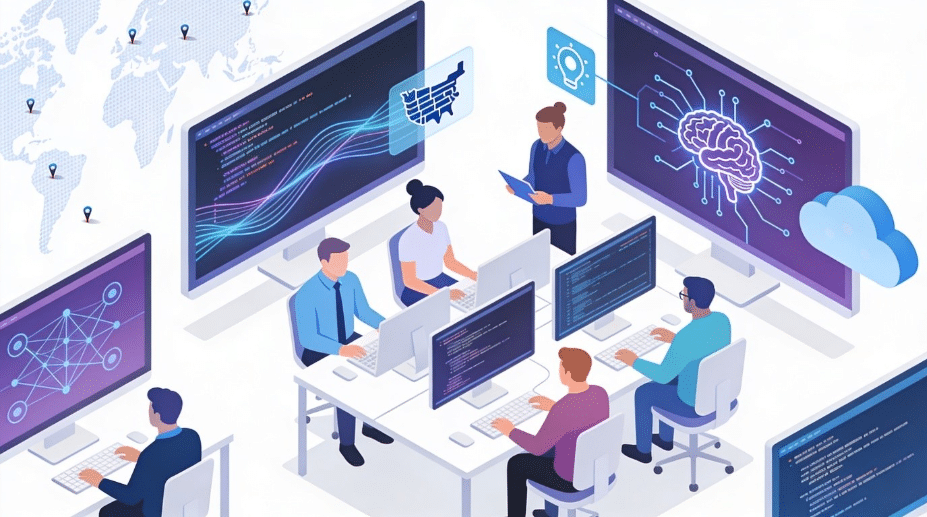
From Code to Intelligence, choosing the right AI software development partner
Why AI in software development matters
AI in software development is no longer a buzzword; it is a practical way to accelerate coding, reduce bugs, and improve product quality across the software lifecycle. Used well, AI helps teams move faster from ideas to requirements, from requirements to code, and from code to safe, observable systems in production.
AI coding assistants can suggest functions, detect vulnerabilities, and refactor legacy modules so engineers can focus on architecture, user experience, and business logic instead of repetitive tasks. In many teams, junior developers use AI to handle boilerplate work, while senior engineers review design choices, edge cases, and performance trade‑offs. The result is more time spent on thinking and less on manual busywork.
This blend of automation and human creativity is what defines a modern AI software development company. The goal is not to replace developers, but to give them better tools and processes so they can deliver value faster and with more confidence.
What an AI software development company does
Most AI‑focused vendors combine traditional software development with specialized AI development services. Instead of just talking about tech stacks, they frame their work around business outcomes: faster delivery, better quality, or new intelligent features.
Typical capabilities include:
- End‑to‑end web and mobile development, with AI‑assisted coding and automated testing.
- Custom AI model development and integration of APIs such as language models, vision, and speech, often deployed as AI‑as‑a‑Service on cloud platforms.
- Data engineering, predictive analytics, and recommendation engines that turn raw data into decisions and personalized experiences.
- Intelligent automation for workflows, from document processing and back‑office operations to customer support chatbots and decision support tools.
A typical project might start with a discovery phase to identify high‑value use cases, then move into system design, model selection, implementation, and integration with existing systems. The stronger vendors stay engaged after launch, monitoring model performance and user feedback and updating models as data and behavior change over time.
If you want a vendor‑neutral overview of how AI fits into each stage of the development lifecycle, IBM’s guide on AI in software development is a useful reference point.
Custom software development with AI
A custom software development company that embeds AI into its work can often deliver tailored solutions faster and more reliably than teams relying purely on manual processes.
During discovery and design, AI tools can analyze requirements, user behavior, and historical data to suggest feature sets and architectures that align better with real‑world usage. For example, a product team planning a new customer portal might analyze support tickets and usage logs with AI to surface the most common pain points before committing to a roadmap.
In implementation, AI helps generate boilerplate code, maintain consistent patterns across services, and enforce coding standards. Developers can use AI to scaffold modules, write tests, or port patterns between languages, while still owning the critical logic and security decisions.
In quality assurance, AI‑based test generation and anomaly detection can reduce production incidents and catch issues earlier. Imagine a retail application where AI constantly scans logs and user flows, alerting the team when error rates spike or a key path slows down after a deployment. That kind of continuous, data‑driven QA is difficult to sustain manually.
Romanian providers like Softech show how custom software development services can scale globally from hubs such as Cluj‑Napoca, combining deep engineering expertise with flexible engagement models for European and US clients.
Staying ahead with software development news
Because AI frameworks and tools change quickly, serious vendors track software development news, releases, and AI model updates as part of their normal routine. The goal is not to adopt every new library, but to know which ones are stable, which are emerging, and which pose security or maintenance risks.
Curated resources such as Dev Weekly by Ajit Singh summarize the most important developer news each week, from model releases to language updates and security issues. Sites like Tech Xplore’s software section highlight research and innovation stories that hint at where the industry is heading next.
An AI software development company that shares its own tech radar or insights gives clients visibility into why certain tools are being used and how those decisions might evolve over the life of a product. That transparency becomes part of the partnership, not just a behind‑the‑scenes technical detail.
Choosing a software development company in the USA (and beyond)
If your business operates in North America, working with a software development company in USA can bring advantages in time zone overlap, regulatory familiarity, and access to local AI ecosystems. Many US‑based firms specialize in AI development services such as generative AI platforms, enterprise consulting, and secure cloud‑native architectures for regulated industries.
Lists like “Top AI Software Development Companies” can help you build an initial shortlist based on domain expertise, tech stack, and industry focus. From there, you can compare US‑based firms with global providers such as Appinventiv or N‑iX to balance cost, experience, and geographic coverage.
In practice, many companies choose a hybrid model: a local partner to define strategy, architecture, and regulatory requirements, and a nearshore or offshore team for scalable delivery and ongoing development. That combination often offers a good mix of control, speed, and budget efficiency.
Matching your goals to the right partner
Different needs call for different types of vendors:
- If you want an end‑to‑end product with AI features, look for an AI‑savvy custom software development company that can own product, data, and infrastructure together.
- If you need deep, enterprise‑grade AI capabilities, a specialized AI development provider may be the best fit.
- If your priority is broad engineering capacity with some AI support, a strong general custom software development company may be enough.
Whether you choose a local custom software development company or a global AI software development company, look for teams that know your industry, use AI thoughtfully across the lifecycle, and stay current on software development news so your product doesn’t quietly fall behind. In a world where every serious company is becoming a software company, those who invest early in AI‑driven development will have a real advantage.