


AI software cost analysis 2026, total cost of ownership, talent, and infrastructure explained
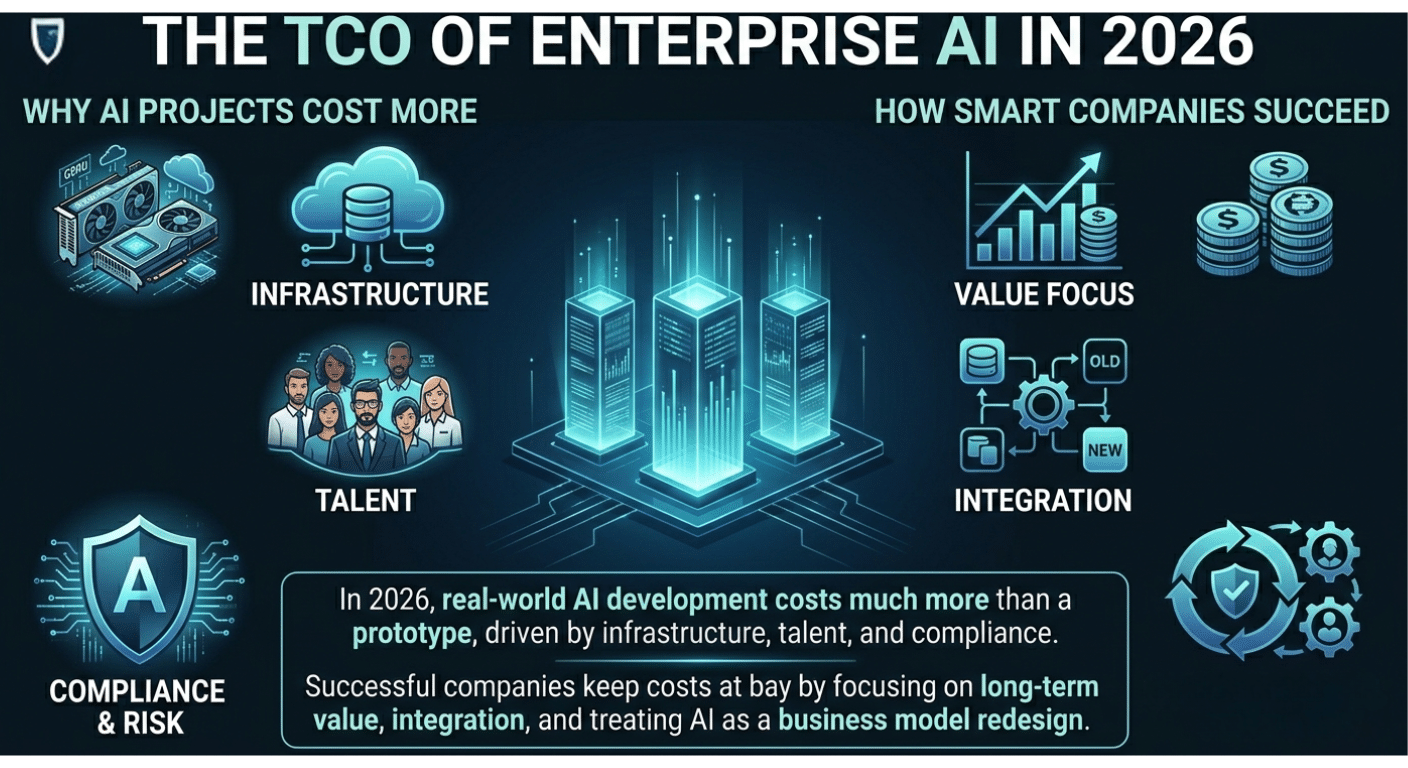
Why AI projects cost more than ever and how smart companies keep costs at bay
When you hear anyone can code professional Ai software with a few prompts and light AI tools you probably roll your eyes if you are an IT professional 😊. Artificial Intelligence is no longer an experimental technology reserved for Silicon Valley giants, however serious AI software development incurs serious costs and consideration, not just a prompt on Claude Code that gets you to a nice mock-up. That may work for someone that has no idea of the serios application development, but it will not work for a bank or for a utility provider. Businesses of every size invest in AI-powered tools, automation systems, customer support bots, predictive analytics, and intelligent SaaS platforms. But while AI adoption is accelerating rapidly, one question dominates every boardroom discussion:
“What is the real total cost of ownership?”
The answer is far more complicated than paying developers to write code. Modern AI development involves infrastructure costs, subscription expenses, compliance requirements, maintenance, and highly specialized talent. A proper AI software development cost analysis is now essential before launching any serious project.
- AI Infrastructure Costsis TheBiggest Expense Nobody Talks About
Most companies underestimate the long-term infrastructure required to run AI systems efficiently.
Infrastructure costs typically account for 10–30% of total AI software development costs, with monthly cloud infrastructure ranging from $500–$50,000+ depending on project scale. Here’s the breakdown:
Infrastructure Cost by Project Scale (Monthly Cloud)
|
Project Scale |
Monthly Infrastructure Cost |
Typical Setup |
|
Small/Prototype |
$500–$2,000 |
Few GPUs, basic storage, light inference |
|
Medium/Mid-Market |
$5,000–$20,000 |
Multiple GPU nodes, moderate training + inference |
|
Large/Enterprise |
$50,000+ |
Dozens of top-tier GPUs (H100/A100), heavy training |
Total AI Development Cost Breakdown (Including Infrastructure)
|
Project Type |
Total Development Cost |
Infrastructure % of Total |
Annual Infrastructure Cost |
|
Basic/Prototype (rule-based bots, simple API) |
$5,000–$30,000 |
10–15% |
$500–$4,500 |
|
Standard/Mid-Market (custom ML, LLM chatbots, CRM integration) |
$30,000–$150,000 |
15–20% |
$4,500–$30,000 |
|
Advanced/Enterprise (deep learning, computer vision, multi-system AI) |
$150,000–$500,000 |
20–25% |
$30,000–$125,000 |
|
Enterprise Platform (custom LLM training, multi-agent, regulated) |
$500,000–$5M+ |
20–30% |
$100,000–$1.5M+ |
Specific Infrastructure Cost Components
|
Component |
Monthly Cost Range |
Notes |
|
GPU Compute (Training) |
$0.66–$6.98/hour |
AWS H100: ~$3–$7/hr (AWS cut prices 45% in 2025) |
|
GPU Compute (Inference at scale) |
$1,000–$50,000/month |
Depends on traffic volume & model size |
|
AWS EC2 (p4d.24xlarge for training) |
$23,594/month |
High-end GPU instance |
|
AWS EC2 (g5.12xlarge for serving) |
$4,975–$5,529/month |
Production deployment |
|
Data Storage (S3 + EBS) |
$1,150–$1,700/month |
8 TB EBS + 20 TB S3 typical |
|
Specialized AI Platforms (Dataiku, SageMaker) |
$1,000–$100,000+/month |
Managed ML services |
|
On-Premise GPU Server |
$50,000–$150,000 upfront + $10,000–$30,000/year |
High upfront capital, no cloud dependency |
Key Infrastructure Cost Drivers
|
Factor |
Impact on Cost |
|
GPU Count & Type |
H100/A100 GPUs dominate costs; 1 GPU vs 50 GPUs = 50x difference |
|
Training vs Inference |
Training is short-term heavy cost; inference is recurring operational cost |
|
Storage (embeddings, logs, raw data) |
Often underestimated; 20–30% of total spend on data+infrastructure |
|
Data Volume & Modality |
Multimodal (text + image + video) increases storage/compute significantly |
|
Scale Predictability |
Subscription model: ±5–10% variance; Usage-based: ±30–50% variance |
Here are some practical rules to consider:
- Annual operational infrastructure costs = 20–40% of initial build cost
- Infrastructure as % of annual AI implementation = 10–20%
- Data + Infrastructure combined = 20–30% of total budget
For example, a custom complex AI chatbot for customer support built form scratch for $100,000 will incur $20,000–$40,000/year in infrastructure/operational costs long term. Of course more AI chatbots can be developed for less, this a complex one we recently developed.
Compute power has become one of the most expensive resources in tech. Whether businesses use proprietary APIs or self-hosted large language models, operational costs grow alongside user activity.
API Pricing and Usage Costs
According to recent updates from OpenAI Official Blog, token pricing structures are becoming more advanced and usage-based. This gives companies flexibility, but also creates unpredictable monthly expenses.
For example a small AI chatbot for customer support may cost only a few thousand dollars per month., while an enterprise-level AI assistant processing millions of prompts can generate six-figure yearly API bills.
Without proper monitoring, businesses often experience “AI bill shock” after scaling usage.
Cloud Hosting and GPU Demand
Companies hosting their own models face additional expenses:
- GPU server rental
- Cloud infrastructure
- Data storage
- Model optimization
- Backup systems
- Cybersecurity protection
Because global AI demand exploded between 2024 and 2026, GPU availability remains limited, keeping infrastructure prices extremely high.
- The Human Cost of AI Development
Technology alone is not the biggest investment anymore, talent is. AI specialists are now among the highest-paid professionals worldwide.
Businesses require experts in Machine Learning Engineering, MLOps, AI Security, Prompt Engineering, AI Ethics & Compliance, Data Architecture.
The rise of professionals who connect AI capabilities with business strategy aka “Intelligence Architects”, has pushed labor costs even higher.
Labor Cost Growth
Compared to previous 3 years, AI development salaries in 2026 are estimated to be 25–40% higher globally.
This is one reason many firms are shifting toward outsourcing or hybrid development teams in regions with lower operational costs but strong engineering talent.
How much it costs to change the SMB financial automation
FinMate AI set out to solve a quiet but costly problem: small businesses drowning in invoices, cash flow uncertainty, and manual report-building. Their vision? A subscription-based AI financial assistant that could analyze invoices predictively, forecast cash flow before it goes red, auto-generate accounting reports, and answer tax or bookkeeping questions in plain language—all through an intuitive chat interface.
To bring this to life, we built a mid-market AI SaaS platform with a total development budget of $123,000, including $18,000 in first-year cloud infrastructure (GPU inference, embedding storage, and API costs). Within 18 months, FinMate served 3,200 small businesses, reduced average bookkeeping time by 14 hours/month per client, and hit $1.1M ARRproving that when AI infrastructure is sized wisely and pricing is tuned for value (not just cost), even a bootstrapped fintech can punch above its weight in a crowded market.
The Hidden Expenses Most Companies Forget
A realistic total cost of ownership includes far more than development.
- Data Acquisition & Cleaning
AI systems are only as good as their data.
In many projects, data cleaning and labeling consume nearly 30% of the total budget. Poor-quality data leads directly to inaccurate AI outputs.
- AI Drift Monitoring
AI models degrade over time as user behavior changes. This phenomenon, called “model drift,” requires continuous retraining and monitoring.
Without maintenance, AI performance can decline significantly within months.
- Security & Compliance
Governments worldwide introduced stricter AI regulations between 2025 and 2026.
Businesses now need:
- AI transparency systems
- Data governance frameworks
- Bias testing
- GDPR/AI Act compliance
- Security audits
Compliance has become a major financial commitment, especially for enterprise SaaS products.
- Integration with Legacy Systems
One of the most underestimated costs is making AI work with old software systems already used by businesses.
Connecting AI to CRMs, ERPs, databases, or accounting platforms often requires months of custom engineering work.
Estimated AI Development Costs in 2026
| Project Scale | Initial Development Cost | Monthly Operational Cost |
| MVP / Prototype | $30,000 – $60,000 | $1,000 – $3,000 |
| Custom Enterprise Tool | $150,000 – $500,000 | $10,000 – $40,000 |
| Complex AI Ecosystem | $1,000,000+ | $100,000+ |
Why Businesses Still Invest in AI
Despite rising costs, companies continue investing aggressively in AI because the long-term return can be enormous.
True AI software custome developed to your needs can:
- Reduce labor costs
- Improve customer support
- Automate repetitive tasks
- Increase operational efficiency
- Generate competitive advantages
For many businesses, the real risk is no longer investing too much in AI, it is investing too late.
AI development is expensive, complex, and highly competitive. Rising infrastructure fees, stricter regulations, and the ongoing cost of living increase 2026 continue to push budgets higher every year.
However, businesses that understand the true total cost of ownership are better positioned to scale intelligently and avoid costly mistakes.
The future belongs to companies that combine innovation with realistic financial planning.