
 Back to all case studies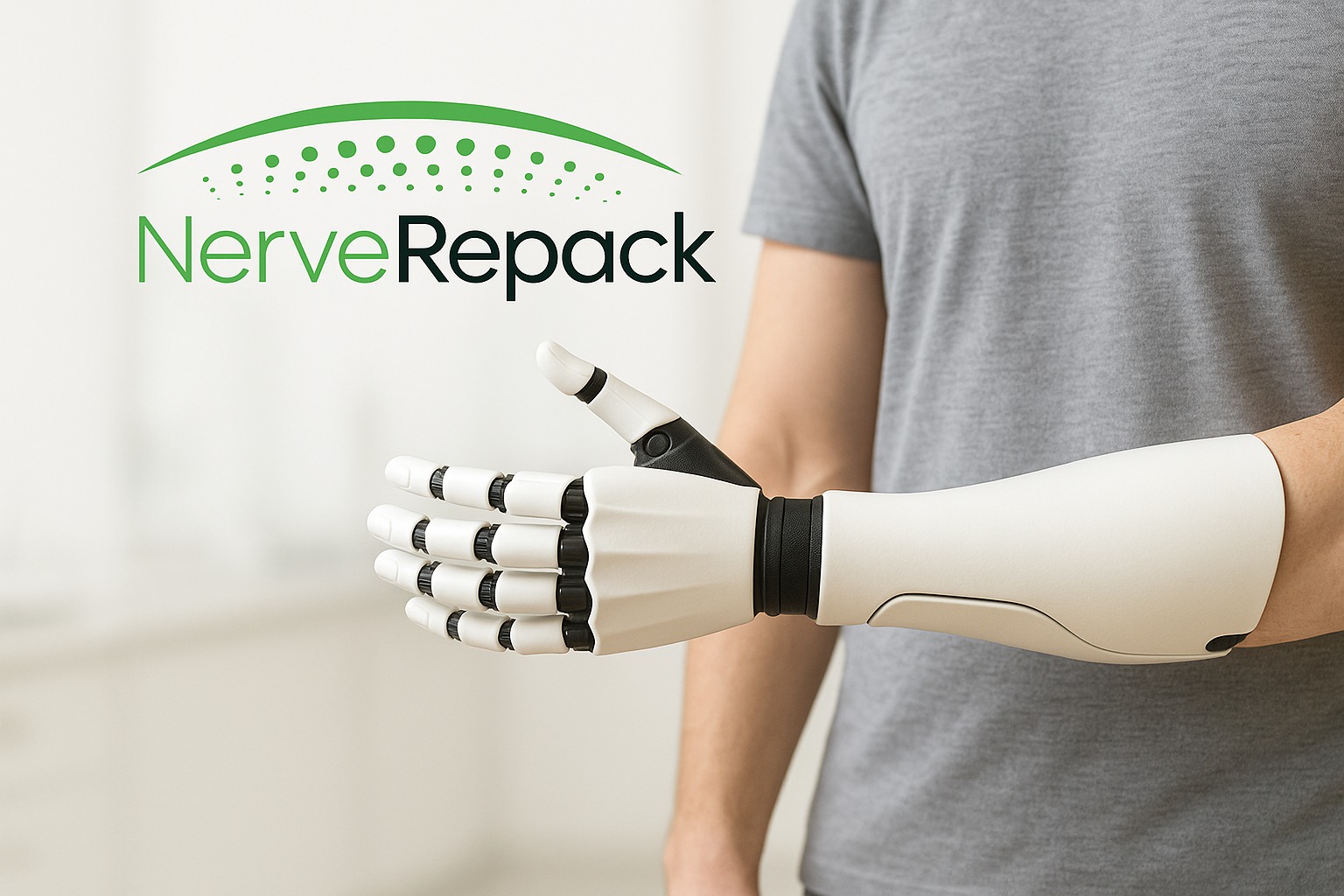
NerveRepack: Advancing Bidirectional Neural Interfaces for Natural Prosthesis Control
NerveRepack is a research & innovation project focused on developing bidirectional implantable neural interfaces that enable more natural control and sensory feedback for prostheses and exoskeletons.
Key results:
- The system achieved an accuracy rate of 98.41% in classifying neural signals by combining mean absolute value (MAV) features with a decision tree algorithm
- The prosthetic control algorithm operates with a computation time of approximately 1 millisecond, enabling virtually real-time responsiveness
- A multi-threaded implementation on a system-on-chip (SoC) platform was used to process signals
An embedded signal processing pipeline that extracts four key time-domain features from electromyography (EMG) signals in real time
NerveRepack is working on highly complex neural interface technology involving implantable electrodes that interact with peripheral nerves (median, ulnar, etc.).
A key part of the challenge is to build algorithms that interpret neural signals (motor commands) and send feedback (sensory signals) in real time. Because the signals and responses must be tightly synchronized, the system requires advanced AI/machine learning for decoding neural commands and mapping those to prosthetic movement, as well as producing tactile feedback via stimulation electrodes. Additionally, NerveRepack must ensure a smooth interface between biological signals and mechatronic device control, manage wireless communication, power, biocompatibility, and safety.
What we
delivered:
User training / adaptation:
support the neural training phase—where the patient uses a glove on the healthy hand to generate paired movement data and help the AI model learn mappings.
Testing & validation:
simulate, test, and validate that the AI-driven control works as intended, ensuring safety and accuracy.
Software integration & real-time system:
integrate all subsystems (neural signal capture, communication, control, feedback) into a real-time pipeline to ensure minimal latency.
Feedback / sensory stimulation algorithms:
design modules that map sensor data from prosthetic fingertips back to stimulation signals for sensory nerves.
AI / Machine Learning development:
build and train algorithms to classify motor neural signals (from implanted electrodes) and translate them into control commands for the prosthetic device.
Concept & system architecture:
define the software architecture connecting neural signal acquisition, AI/ML modules, and prosthetic control systems.
Qualitative results:
A pioneering AI-driven neuroprosthetic system, which could serve as a technological platform for further research, commercialization, and scaling to broader amputee populations.
Significant quality of life improvement for amputees, by restoring both motion and sensation in a more embodied way.
A bidirectional neural interface, closing the loop between brain / nervous system and prosthetic device, pushing prosthetics closer to the natural human-limb experience.
Tactile feedback, via feedback electrodes stimulating sensory nerves, giving the user sensation during interactions (e.g., feeling pressure when touching objects).
A prosthesis that can be controlled directly by the user’s neural signals (motor commands) for finer, more intuitive movement.
“The NerveRepack project was created to answer an urgent need to help people with severe nerve damage affecting their upper or lower limbs. These people suffer amputations or paralysis, and their ability to move, to work, to take care of themselves is severely diminished or lost. NerveRepack will have a significant impact on people’s quality of life and health.”
Explore more case studies


IKEA

Internal platforms for furniture configuration and 3D simulators, enabling better customer and staff experiences, and streamlining the customization process.
Allianz
We implemented automated testing systems across global insurance platforms, ensuring compliance, improving reliability, and accelerating time-to-market for new features.
Raiffeisen
We introduced automated testing and CI/CD pipelines for banking platforms, reducing release cycles, improving reliability, and enabling faster innovation.
Orange
We managed large-scale data engineering and data migration from legacy systems to Google Cloud Platform, enhancing analytics capabilities.
Rave Guardian (Rave Mobile Safety)
We developed a campus safety app with real-time notifications, interactive maps, and advanced security features.
Dell Financial Services
We scaled IT talent and project delivery for Dell’s global operations hub in Bucharest, providing agile development resources and support.
Protected Areas Management (NE Guard Romania)
We built environmental management software with geo-registration, incident reporting, and analytics capabilities for conservation agencies.
Motus
We migrated a legacy mileage-tracking platform to a microservices architecture, improving performance and maintainability.
Quantrio Consulting
We created a supervision and mobile reporting platform with mapping, activity tracking, and analytics to support smarter environmental operations.
NNC Services
We modernized a direct-mailing platform to boost efficiency, scalability, and delivery speed, so marketing teams can run campaigns more effectively.
Enea Services
We delivered custom communication systems and specialized IT consulting services for enterprise clients.
Armin (Representative highlight)
We partnered on AI-driven automation and robotics engineering projects, developing proof-of-concepts and guiding them from prototypes to production-ready systems.