


Medical device R&D software engineering under EU MDR, ISO 13485, IEC 62304 and the FDA QMSR
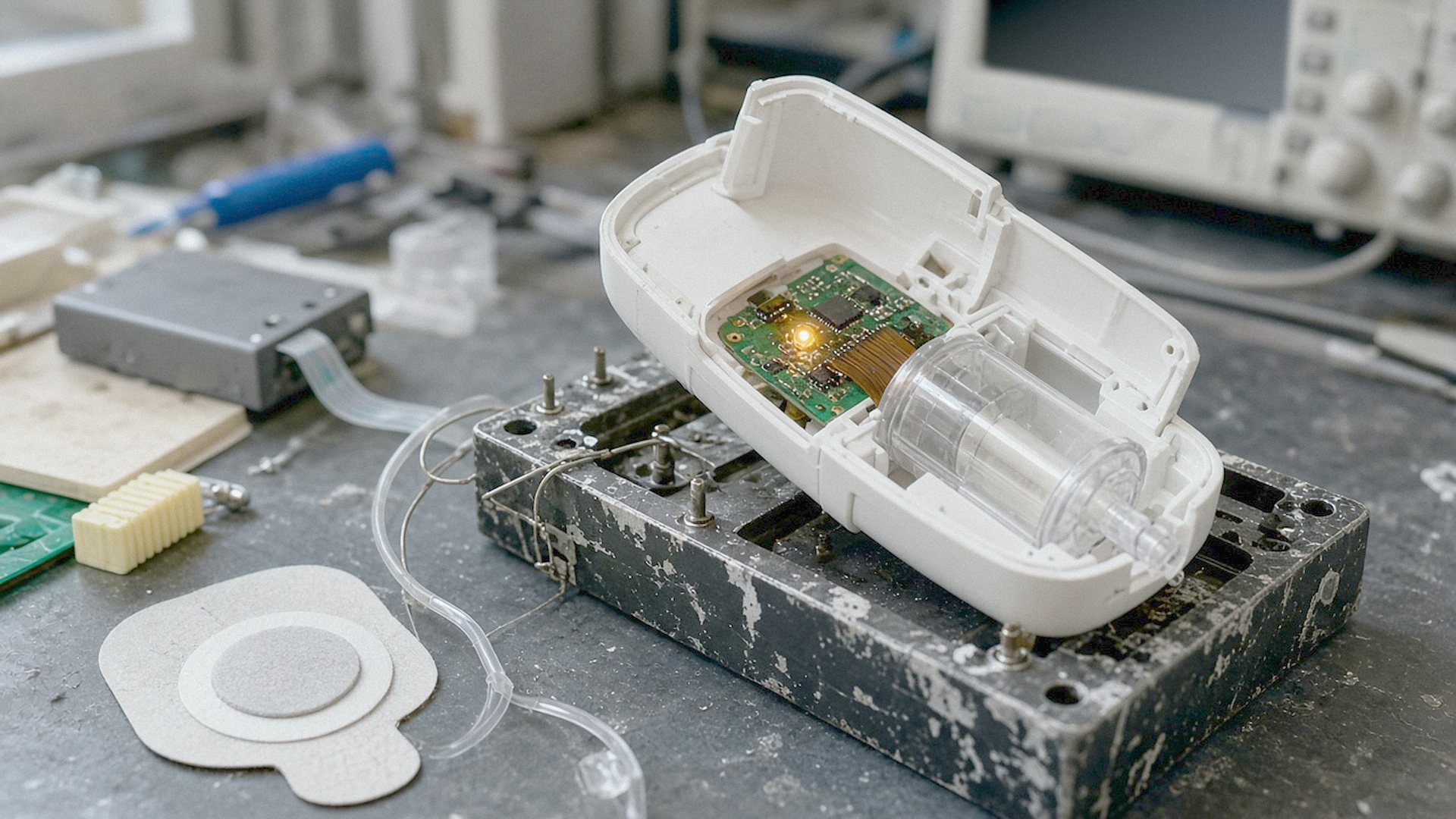
Picture a fictional device startup, four months into a promising prototype. The algorithm works on the bench, and the CEO asks when the code can go into the product. Then the QA/RA lead asks a quieter question: when did design controls start, and which of this code is under them? If nobody wrote that moment down, months of good engineering become evidence you have to reconstruct.
That question decides whether your first design review is calm or frantic. The EU MDR sets the requirements, ISO 13485 runs the quality system, IEC 62304 defines the software lifecycle, and since 2 February 2026 the FDA QMSR applies ISO 13485 in the US. What’s usually missing is one recorded decision: the line where research stops.
Here’s where to draw it, what to record from the first sprint, and how to bring in outside engineers without losing control. See our page on medical device research and development. This is engineering guidance, not regulatory advice: the manufacturer, and its notified body or FDA reviewer, make the classification and conformity decisions.
When does medical device R&D become regulated design and development?
Design and development controls start when research ends, and you should record that point as a decision. FDA training material on the QMSR says design and development requirements are not intended to apply to feasibility studies or proof of concept, and recommends starting them when research is ending. Manufacturers should document where research ends and design and development begins.
There is also a latest point: before a clinical evaluation such as an investigational device exemption (IDE) under 21 CFR 812, and before submitting a 510(k), De Novo, PMA or HDE. FDA notes that this list is not exhaustive. The requirements also apply when a marketed device is changed, and they are not intended to be retroactive.
An IDE is not a shortcut. FDA’s QMSR page says devices made under an IDE are not exempt from the design and development requirements in 21 CFR 820.10(c) and ISO 13485 clause 7.3.
The EU MDR reaches the same boundary another way. Annex I, Section 17.2 requires that device software be “developed and manufactured in accordance with the state of the art taking into account the principles of development life cycle, risk management, including information security, verification and validation”. Exploration can be informal; device software needs a lifecycle record. So write the boundary down in a short design and development entry decision, approved in your QMS, naming which prototypes, findings and code carry forward.
How do EU MDR, ISO 13485, IEC 62304 and the FDA QMSR fit together?
The EU MDR and the FDA QMSR are law, ISO 13485 is the quality system both rely on, and IEC 62304 turns its design controls into software tasks.
The EU MDR, Regulation (EU) 2017/745, binds the manufacturer placing the device on the EU market and expects software verification and validation in the technical documentation (Annex II, Section 6.1(b)).
Its quality system duty sits in Article 10(9): a QMS that addresses, among other things, risk management, product realization “including planning, design, development, production and service provision”, and “selection and control of suppliers and sub-contractors”.
ISO 13485:2016 binds the organization that adopts it. Clause 7.3 asks for planned, reviewed, verified, validated and transferred design and development, and clause 7.4 covers supplier control. The QMSR makes it mandatory in the US, and in the EU it supports presumption of conformity.
In the EU detail, EN ISO 13485:2016, with its 2018 corrigendum and amendment A11:2021, is listed under Commission Implementing Decision (EU) 2021/1182 as a harmonized standard for the MDR. EN ISO 14971:2019 with A11:2021, the risk management standard, is listed too.
IEC 62304:2006+AMD1:2015 covers development planning, requirements, architecture, unit and integration work, system testing, release, maintenance, risk management, configuration management and problem resolution, scaled by software safety class. It binds whoever applies it; the manufacturer decides and documents that. It’s the widely used route to Annex I 17.2, but check the Commission’s current list of harmonized standards before claiming a presumption of conformity from it in a technical file, and otherwise treat it as the state of the art you engineer against. The IEC also says it does not cover validation and final release of the medical device, even when the device is entirely software. Device validation sits in the manufacturer’s quality system.
The FDA QMSR, 21 CFR Part 820, is a US regulation effective 2 Feb 2026. It incorporates ISO 13485:2016 and clause 3 of ISO 9000:2015 by reference, plus FDA-specific provisions, and binds finished device manufacturers who intend to commercially distribute in the US. For more, read ISO 13485 vs IEC 62304: what your software vendor must prove.
What changed for software R&D teams with the FDA QMSR?
Since 2 February 2026, US design controls follow ISO 13485, risk management is explicit, and FDA inspects under a new compliance program. FDA calls the old and new requirements substantively similar, so ISO 13485 teams start with a gap analysis.
The FDA QMSR gives the US and the EU one quality framework; where ISO 13485 conflicts with the FD&C Act or its regulations, FDA’s own rules control. FDA says incorporating ISO 13485 “now specifically requires risk management”, and its training ties risk-based decisions to design and development, purchasing and QMS software validation.
Scope matters for software. Under 21 CFR 820.10(c), manufacturers of Class II and Class III devices, and of Class I devices automated with computer software, must comply with ISO 13485 clause 7.3 and its subclauses, so software-driven Class I devices are inside design controls.
On 2 February 2026, FDA also stopped using the Quality System Inspection Technique (QSIT) and began inspecting under Compliance Program 7382.850. In a January 2026 town hall, it described ISO 13485 and the 1996 Quality System Regulation as substantively similar, said it does not expect manufacturers to retroactively reference ISO 13485 in design files created before 2 February 2026 or to remove older terms such as “design history file”, and encouraged a gap analysis for older designs still marketed after that date.
Two guidance documents sit next to the QMSR. FDA’s June 2023 guidance on premarket submissions for device software functions sets two documentation levels, Basic and Enhanced, based on whether a software failure could present a hazardous situation with a probable risk of death or serious injury, and expects evidence that planning, requirements, risk assessment, design reviews, traceability, change management and testing were in place. FDA’s Computer Software Assurance for Production and Quality Management System Software guidance (February 2026) describes a risk-based approach to software used in production or the quality system, and supersedes the version issued on 24 September 2025.
How should you set up an R&D software program so evidence starts on day one?
Plan before you code: once design and development starts, record the software development plan, safety class, lifecycle model, toolchain and configuration baseline, and link every requirement to a risk control and a test from the first sprint.
| R&D stage | Records worth keeping | Main hooks |
|---|---|---|
| Research and feasibility | Decision log, assumptions, tagged prototype code, early SOUP notes | Outside design controls (FDA training); document where research ends |
| Design and development planning | Design and development plan, software development plan | ISO 13485 7.3.2; IEC 62304 4.3 and 5.1; 21 CFR 820.10(c) |
| Inputs and software requirements | Requirements with stable IDs, risk analysis, first trace links | ISO 13485 7.3.3; IEC 62304 5.2; ISO 14971 |
| Architecture and implementation | Architecture description, SOUP list with versions, review records | ISO 13485 7.3.4; IEC 62304 5.3 to 5.5 |
| Verification | Verification records tied to a specific build | ISO 13485 7.3.6; IEC 62304 5.5 to 5.7; MDR Annex II 6.1(b) |
| Release and validation | Release package, anomaly list, validation records (device validation by the manufacturer) | IEC 62304 5.8; ISO 13485 7.3.7 |
| Design transfer | Build and release procedure, configuration item list | ISO 13485 7.3.8 |
| Changes and maintenance | Change requests, impact analysis, regression results | ISO 13485 7.3.9; IEC 62304 clauses 6, 8 and 9 |
Five set-up decisions carry most of the weight; we’d agree each with your QA/RA lead in week one:
- Safety class, in writing. IEC 62304 scales documentation and verification by Class A, B or C; record the rationale against the risk analysis and revisit it when the architecture changes.
- Stable IDs and one trace for requirements, risk controls, software items and tests. Our guide to ISO 13485 traceability and IEC 62304 verification shows the minimum columns and two-way checks.
- Configuration management from the first commit, including each SOUP item and version. A build you can’t reproduce can’t be verified or transferred.
- CI that keeps records. Results stored per build ID are verification evidence; don’t discard them after a green run.
- Validated tools. Tools holding quality records are QMS software. ISO 13485 clause 4.1.6 requires their validation, proportionate to risk, and FDA’s CSA guidance gives a risk-based method.
How do you keep prototype code from becoming undocumented device software?
Decide at the research boundary which prototype code moves forward, then specify, design, review and verify it under the plan like any new software. Code that skips that step ends up in the device with no lifecycle record, the gap Annex I 17.2 and IEC 62304 exist to prevent.
Freeze the feasibility repository once research ends, and promote reused modules rather than copying them. Open-source libraries from feasibility become SOUP: list them with versions and assess them in the risk analysis before they enter the product build. Exploration can continue on branches outside the release pipeline.
How should regulated R&D handle cybersecurity and data?
Treat security as a design input from the start, and build threat modeling, SBOM generation and access control into the R&D pipeline.
In the EU, Annex I 17.2 includes “information security” in the lifecycle requirement, and Annex I 17.4 asks manufacturers to set minimum requirements for hardware, IT networks characteristics and IT security measures, including protection against unauthorized access.
MDCG 2019-16 rev.1 is the Commission-endorsed guidance on cybersecurity for medical devices.
In the US, Section 524B of the FD&C Act requires sponsors of cyber devices to submit a plan for postmarket vulnerabilities, processes for reasonable assurance of cybersecurity, and a software bill of materials covering commercial, open-source and off-the-shelf components. FDA’s cybersecurity guidance was updated in February 2026; premarket cybersecurity in depth is a topic for a later post.
If R&D involves machine learning, agree up front where data lives and who can use it. At Areusdev, client data is never used to train shared models without a written agreement. See our due diligence FAQ for questions to put to any partner, and CRA vs MDR for health software for SBOM and update questions.
How do you run regulated R&D with an external engineering team?
Treat the external team as a supplier inside your quality system. You keep intended use, classification, risk acceptance, validation and release; the partner works to your procedures under a quality agreement and hands over evidence each release.
ISO 13485 clause 4.1.5 keeps outsourced processes under the manufacturer’s control, with quality agreements, and clause 7.4 sets purchasing and supplier controls, proportionate to risk. Through the QMSR, the same clauses apply in the US.
In the EU, Article 10(9) brings supplier and sub-contractor control into the quality system, and the technical documentation must identify all sites, including suppliers and sub-contractors, where design and manufacturing activities are performed (Annex II, Section 3(c)).
Under Annex IX, Sections 3.3 and 3.4, surveillance and unannounced audits can include suppliers’ and subcontractors’ premises where appropriate, so a partner doing design work should be ready to host one.
Four habits make this work week to week:
- Agree the split in the quality agreement. The traceability and verification guide has a typical split and a per-release handover pack.
- Work in your tools, or deliver exports with stable IDs you can import.
- Include the partner in design reviews. ISO 13485 clause 7.3.5 requires representatives of the functions concerned with the stage under review, often the people who wrote the code.
- Plan for audits: keep the partner’s build, test and access records ready for your auditors, your notified body or FDA.
Still shortlisting? Try our regulated software partner scorecard.
What slows medical device R&D software programs down?
Mostly avoidable gaps: no recorded research boundary, a safety class decided late, requirements without risk links (add a risk control reference or an explicit “none”), and design transfer treated as a hardware topic. The other trap is planning to drafts. IEC 62304 Edition 2 is still in development, with a committee-draft ballot opened in August 2026, and one industry tracker forecasts publication in 2028; dates may move. The Commission’s December 2025 proposal to simplify the MDR and IVDR is still in the legislative process. Work to the current texts and track both.
How does Areusdev fit into a medical device R&D program?
We engineer device and health software inside your ISO 13485 quality system, following IEC 62304 lifecycle practices. We’ve been doing this since 2004, and 17 of our 72 people work in healthtech engineering. ISO 13485, IEC 62304 and ISO 14971 are standards we engineer against.
We agree the research boundary, safety class, trace structure and export formats with your R&D and QA/RA leads, then keep the software record current to design transfer. Classification, conformity and release decisions stay yours. Public R&D work includes NerveRepack, an EU research consortium where Areusdev contributes regulated R&D and exoskeleton mechatronics engineering. Learn more about our R&D engineering services and healthcare software development.
If you take one thing away: draw the research boundary on purpose and write it down. This week, ask your team when design controls started and which code they cover. If the answers differ, that’s your first task.
Plan your medical device R&D software work with us
Bring your intended use, your QMS procedures and the point your program has reached, from feasibility to release. Areusdev will show how its engineering and evidence plug into your design controls.
Frequently asked questions
When do design controls start in medical device R&D?
When research and feasibility end and the device design begins. FDA’s QMSR training says the requirements are not intended to apply to feasibility or proof of concept, but they are required before clinical evaluation such as an IDE and before a marketing submission, so document the boundary in your QMS.
Can prototype code from a feasibility study be used in the final device?
Yes, once it is brought under the software lifecycle with requirements, design review, a place in the architecture and recorded verification. Code that skips this has no lifecycle record, which conflicts with MDR Annex I 17.2.
Does the FDA QMSR change software R&D if we already follow ISO 13485?
Not much. FDA describes ISO 13485 and the old Quality System Regulation as substantively similar, and the QMSR now incorporates ISO 13485 by reference, so teams that already follow it mainly need a gap analysis, especially for older designs still marketed after 2 February 2026.
Do QMSR design controls apply to software for Class I devices?
Yes, when the device is automated with computer software. Under 21 CFR 820.10(c) those devices must comply with ISO 13485 clause 7.3, as do a handful of other listed Class I devices; classification itself is the manufacturer’s decision.
Can a notified body audit our software development partner?
Yes, where appropriate. Under EU MDR Annex IX, Sections 3.3 and 3.4, surveillance and unannounced audits can include suppliers’ and subcontractors’ premises, so give your partner a duty to host and support them in the quality agreement.
Will IEC 62304 Edition 2 or the MDR revision change how we run R&D now?
Not yet. Edition 2 is at committee-draft stage, with publication forecast for 2028 (not confirmed by IEC), and the December 2025 MDR and IVDR simplification proposal is still in the legislative process. Keep working to IEC 62304:2006+AMD1:2015 and the current MDR text.