
Buyer resource / editable RFP
RFP template for choosing a regulated software engineering partner
A free RFP template for buyers who must defend their choice of software partner to QA, vendor risk, security and, sometimes, an auditor. It turns the shortlisting scorecard into questions vendors answer with evidence: pass/fail gates, evidence requests per criterion, contract requirements and a scoring sheet with working formulas.
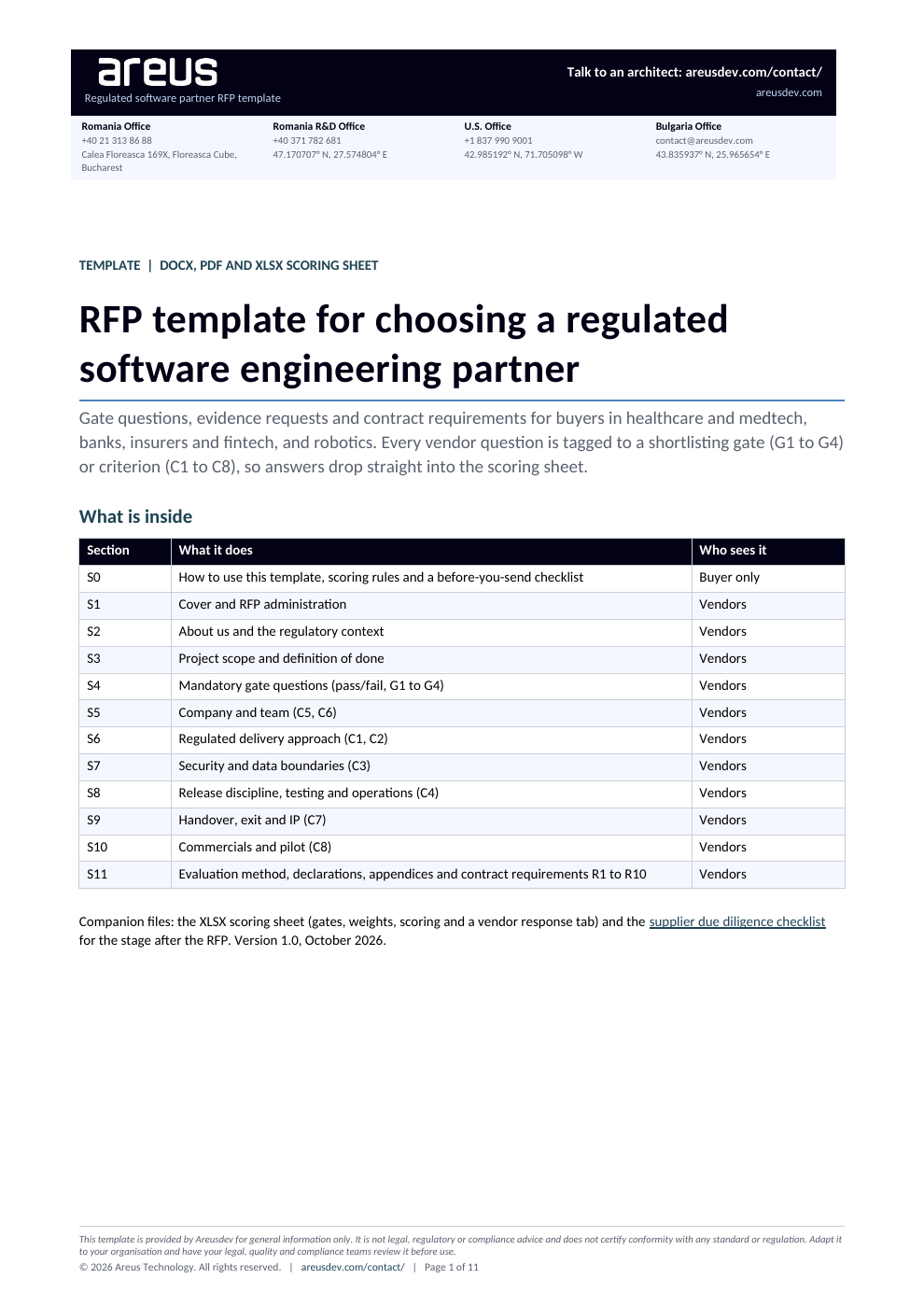 View document preview ↗
What is in the RFP template
The template has 12 sections. S0 is a buyer-only guide that you delete before sending. S1 to S11 go to vendors: administration, regulatory context, scope and definition of done, pass/fail gate questions, team, delivery approach, security, release discipline, handover and exit, commercials and pilot, and the evaluation method.
You get three files:
Editable RFP
DOCX (editable): the full RFP, with every vendor question numbered and tagged, and Appendix A listing contract requirements R1 to R10 that vendors accept, redline or reject.
PDF preview
PDF: a preview of the same document to share with reviewers.
Scoring sheet
XLSX scoring sheet: gates, suggested starting weights with sector variants, weighted scoring with an evidence ID per score, an evidence log, an illustrative example and a vendor response tab.
After the RFP, use the supplier due diligence checklist to record the evidence each shortlisted vendor sends, and the AI and software partner due diligence FAQ for the questions to ask at that stage.
Who it is for
The template is for regulated buyers choosing a software engineering partner: medical device and healthcare companies, banks, insurers and fintech firms, and robotics and industrial automation teams. Inside those organisations, it serves QA/RA leads, vendor risk and procurement, the CTO or head of engineering, and the DPO and CISO who review responses.
Medtech buyers can pair it with our guide to what your software vendor must prove under ISO 13485 and IEC 62304. Financial services buyers can use the fintech partner questions, and robotics teams the robotics partner questions, for follow-ups after the RFP.
Healthcare and medtech
Banking, insurance and fintech
Robotics and industrial automation
How the template fits the shortlisting scorecard
The scorecard is how you judge; the RFP is how you collect the evidence. Every vendor question carries a tag for one of four pass/fail gates (G1 to G4) or one of eight weighted criteria (C1 to C8), so each answer drops into the matching row of the scoring sheet.
The gates, criteria, red flags and scoring rules are explained in the shortlisting scorecard. The scoring sheet uses the same suggested starting weights and lets you switch to a sector variant or your own weights before proposals arrive. A score without an evidence ID counts as zero, so every number can be traced back to a document, demo or reference call.
Four pass/fail gates
Eight weighted criteria
How to use it: RFI, RFP, deep dive, paid pilot, contract
Use the gate questions in a short RFI to screen vendors, then send the full RFP to those who pass. Review redacted artifacts and a live pipeline in a deep dive, run a short paid pilot with the top one or two vendors, and carry the gate answers into the contract so they survive signature.
- Before you send: agree scope, write down what “production-ready” means, set the weights and name your reviewers. The S0 checklist covers this.
- RFI: send S4 (gates) with S1 and S2 to screen the longlist.
- RFP: send S1 to S11 and the vendor response tab to vendors that pass the gates.
- Deep dive: review redacted lifecycle records and a trace export, watch a live pipeline demo and hold reference calls.
- Paid pilot: score a small, representative workstream against the same criteria.
- Contract: turn the accepted requirements R1 to R10 into contract terms with your legal team.
What the template does not do
The template is not legal advice and does not certify any vendor or product. It lists the contract topics vendors must respond to, such as the quality agreement, ICT terms, processor terms, audit rights, IP and exit, but your legal team owns the final wording and your quality and compliance teams own the decision.
This template is provided by Areusdev for general information only. It is not legal, regulatory or compliance advice and does not certify conformity with any standard or regulation. Adapt it to your organisation and have your legal, quality and compliance teams review it before use.
About this template
Areusdev is an engineering partner for regulated industries, building and integrating software since 2004. We are 72 people, 17 of them in healthtech engineering. We work under our clients’ quality and control frameworks, and we do not certify conformity or give legal advice. At Areusdev, client data is never used to train shared models without a written agreement. Custom software for regulated products | Talk to an architect
Before you download
Frequently asked questions
What should an RFP for a regulated software partner include?
It should include your scope and definition of done, the regulatory frame the work sits under, pass/fail gate questions on your quality and contract terms, data use, audit rights and exit, evidence requests for each scored criterion, commercials with a paid pilot option, and the evaluation method. Ask for evidence, such as redacted records and demos, rather than claims.
How is this RFP template different from a vendor selection scorecard?
The scorecard is how you judge vendors; the RFP is how you collect what you judge them on. In this template, every question is tagged to a scorecard gate or criterion, so a vendor’s answer goes straight into the matching row of the scoring sheet, and your reviewers can trace each score back to the evidence behind it.
Can I use the template for both medtech and fintech projects?
Yes. Section S2 sets the regulatory frame, for example your QMS and IEC 62304 for medtech, or DORA and GDPR for a bank or fintech, and the scoring sheet includes weight variants for healthcare and medtech, financial services, and robotics. Delete the questions and appendices that do not apply before you send it to vendors.
Does the template include contract clauses?
No. It lists the contract topics vendors must respond to, such as the quality agreement, ICT contract terms, processor terms, audit rights, IP and exit, written as buyer requirements that vendors accept, redline or reject. Your legal team supplies the actual contract wording. The template is a starting point, not legal advice.
Should we ask vendors for certificates in the RFP?
You can ask which certificates or attestations a vendor holds and what their scope is, and you should verify that scope with the issuer. Score process evidence, though, not the certificate itself. A certificate does not show how this team will work on your project; redacted lifecycle records, trace exports and a live pipeline demo do.
Download the RFP template
Get the editable DOCX, the PDF preview and the XLSX scoring sheet. The files open on the next page.