


How can biotech labs turn AI prototypes into production-ready software?
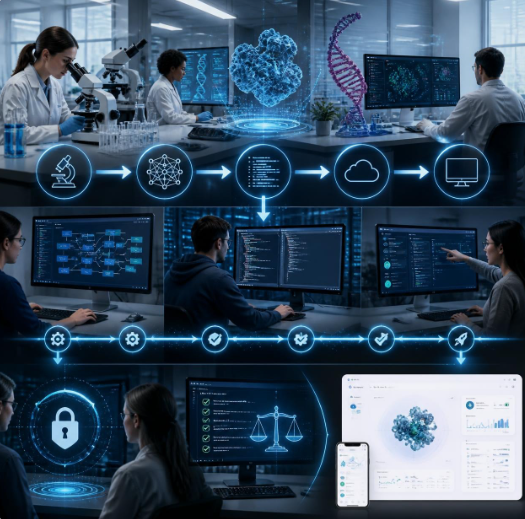
How can biotech labs turn AI prototypes into production-ready software?
A biotech lab can build an impressive AI prototype in a few weeks. Turning that prototype into reliable, secure, production-ready software is a different challenge entirely.
A prototype may successfully classify images, search research documents, predict molecular properties, or answer questions from scientific data. But production software must also work with real users, real laboratory systems, incomplete datasets, strict security controls, and changing business requirements.
The journey from prototype to production is where many biotech AI projects slow down, or stop altogether. Common obstacles include fragmented data, weak system integration, limited explainability, and regulatory requirements introduced too late in the development process.
The solution is not to abandon experimentation. It is to create a structured path from proof of concept to a scalable AI platform.
Why Biotech AI Prototypes Fail to Scale
Most prototypes are designed to answer one question:
Can this AI model work?
Production software must answer several more:
- Can scientists use it without extensive technical training?
- Can it connect to laboratory instruments and existing databases?
- Can users trust and verify its outputs?
- Can the system handle larger datasets and more simultaneous users?
- Can the organization monitor performance, security, and cost?
- Can every important action be documented and audited?
A prototype usually runs on a small dataset, a developer’s environment, or a temporary cloud setup. It may rely on manual data preparation, hard-coded workflows, or a single model that has not been tested against real-world edge cases.
Production software requires a broader foundation: reliable data pipelines, scalable architecture, access controls, monitoring, testing, documentation, and operational ownership.
This is why biotech organizations should treat the prototype as a starting point, not the final product.
A Practical Path to Production
- Define the business and scientific outcome
Before rebuilding the prototype, clarify what success means.
Is the goal to reduce the time spent searching scientific documents? Improve experiment prioritization? Support quality teams? Automate a repetitive laboratory workflow?
A clear outcome helps teams choose the right model, data, integrations, and performance metrics. It also prevents the project from becoming an open-ended AI experiment.
For example, “build a generative AI assistant” is too broad. “Help researchers find validated answers across internal reports in under one minute, with source references” is much more actionable.
For more guidance, see our internal resource: AI strategy consulting for biotech.
- Audit the data before scaling the model
Data quality often determines the success of the final system more than model selection.
Biotech data may exist across laboratory information management systems, electronic laboratory notebooks, spreadsheets, research papers, instrument outputs, and document repositories. These sources may use different formats, naming conventions, and access permissions.
Before moving into production, teams should assess:
- Data completeness and accuracy.
- Metadata and labelling standards.
- Duplicate or conflicting records.
- Data ownership and usage rights.
- Sensitive information and access requirements.
- How new data will enter the system.
A strong data foundation enables better AI performance and makes future model updates more manageable. Multimodal biotech systems are especially dependent on high-quality, representative data because text, images, molecular structures, and experimental results introduce different quality and governance challenges.
- Design the production architecture
The production version should be designed around the laboratory’s existing technology environment.
This may include:
- Cloud or hybrid infrastructure.
- Secure APIs for laboratory systems.
- Retrieval-augmented generation for document-based AI.
- Model registries and version control.
- Automated testing and deployment pipelines.
- Role-based access and audit logs.
- Monitoring for accuracy, latency, usage, and cost.
The goal is not always to build the largest or most complex AI system. It is to build the smallest reliable architecture that can support the intended workflow and grow with demand.
- Test with real-world scenarios
A model that performs well in a demonstration may behave differently when exposed to incomplete records, unusual terminology, outdated documents, or unexpected user questions.
Testing should include:
- Accuracy and relevance evaluations.
- Security and privacy testing.
- Load and performance testing.
- Failure and recovery scenarios.
- Human review of high-risk outputs.
- Testing against edge cases and known limitations.
For scientific or regulated workflows, the system should also provide traceability. Users need to understand where an answer came from, which data was used, and when the model or source was updated.
- Introduce governance from day one
Governance should not be added after the product is built. It should be part of the architecture.
Depending on the use case, this may include data protection, intellectual property controls, model documentation, approval workflows, validation records, and monitoring for model drift.
The system should also clearly distinguish between AI-generated suggestions and verified scientific conclusions. Human experts must remain involved wherever an incorrect output could affect research decisions, product quality, or patient safety.
Case Study: From Document Search to an AI Research Assistant
A biotechnology company wanted to make its large collection of scientific and operational documents easier to use. Researchers were spending significant time locating relevant information across different file types and repositories.
Instead of deploying a basic chatbot, the company worked with a technology partner to build a scalable search and virtual assistant platform using Google Vertex AI and Gemini. The solution included specialized document parsers to interpret different formats and was designed to support function-specific assistants, such as operations and legal research agents.
The important lesson is that the value did not come from the language model alone. It came from combining the model with:
- Structured document processing.
- A scalable cloud platform.
- Search designed around biotech workflows.
- Function-specific access and use cases.
- An architecture that could expand over time.
This is the difference between an AI demo and a production capability.
The Production-Readiness Checklist
Before launching a biotech AI system, ask:
- Is the business outcome measurable?
- Are the data sources clean, documented, and accessible?
- Can the system integrate with existing laboratory software?
- Are security, privacy, and intellectual property controls in place?
- Can users verify the AI’s output?
- Are model performance and costs monitored continuously?
- Is there a clear process for updates, incidents, and human review?
- Can the architecture support more users, data, and use cases?
A well-defined transition plan may include discovery, architecture design, staged development, validation, deployment, and staff training. This approach helps teams identify technical and compliance risks before they become expensive production problems.
From Prototype to Platform
The fastest route to production is rarely the shortest route through development. It is the route that combines scientific ambition with engineering discipline.
Biotech labs that succeed with AI build more than a working model. They create a dependable software platform, one that integrates with existing workflows, protects sensitive data, supports human expertise, and improves as the organization learns.
If your lab has an AI prototype that is ready for its next stage, explore our AI software development services for biotech or read our guide to building a scalable data and AI platform.